


Witness Testimony




Keywords from Transcript
mRNA integrity variation, spike protein isoforms, translation heterogeneity, thrombocytopenia case, lipid nanoparticle inflammation, biodistribution organs, breast milk transfer, RNA persistence months, nuclear entry concern, reverse transcription potential, dosage inconsistency, antibody variability, autoimmune risk theory, 14-day vaccination definition, Digital Services Act censorship
Included in the Report:


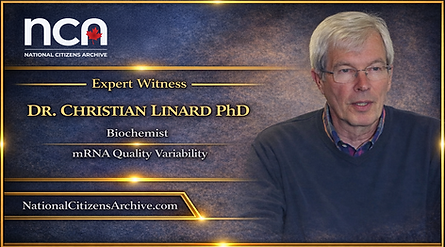
Dr. Christian Linard PhD
Biochemist
Expert
Witness ID:
NCI-W-231
Hearing
Québec City
Québec
Date:
May 11, 2023
Report
Inquiry into the Appropriateness and Efficacy of the COVID-19 Response in Canada; November 2023
Main Topic
Biochemical critique of mRNA COVID-19 vaccine quality control, spike protein variability, biodistribution, genomic integration potential, and implications for immune response and public policy.
One Line Summary
A clinical biochemistry professor argues that mRNA vaccine quality variability and spike protein heterogeneity raise safety, immunological, and policy concerns.
Synopsis
Christian Linard, PhD in biochemistry and professor of clinical biochemistry at the Université du Québec à Trois-Rivières, testified regarding the molecular characteristics of mRNA COVID-19 vaccines. He explained the mechanism of mRNA vaccination, describing how lipid nanoparticles deliver synthetic RNA encoding the spike protein into cells for translation. He stated that published analyses indicated variability in mRNA integrity, with some batches containing significant proportions of truncated RNA. He further presented data suggesting variability in spike protein expression among individuals, including differences in antigen production levels and duration, as well as heterogeneity in antibody responses.
Linard described laboratory findings indicating that spike protein isoforms may be produced due to glycosylation and translation variability, and that RNA persistence could last longer than initially expected. He expressed concern about biodistribution studies indicating mRNA presence in multiple organs, including reproductive tissues and breast milk. He also discussed theoretical mechanisms of reverse transcription, stating that while genomic integration would likely be rare, it could not be categorically excluded. He argued that variability in mRNA length and protein expression results in inconsistent dosing and immune responses, potentially contributing to adverse reactions such as thrombocytopenia and autoimmune phenomena.
Beyond molecular analysis, Linard raised concerns about public health definitions and policy, including the classification of individuals as vaccinated only after 14 days, which he argued could affect data interpretation. He criticized political rhetoric directed at vaccine-hesitant individuals and expressed apprehension regarding emerging legislation such as the European Digital Services Act and Canada’s Bill C-11, which he stated could restrict scientific debate and online discourse. He concluded by emphasizing the importance of open scientific discussion, critical thinking, and caution in the deployment of novel biotechnological interventions at population scale.
🔎 How to Search the Transcript
Click the “Read Transcript” button to open the witness testimony in your browser.
Once the transcript PDF is open, you can search for any word or phrase within the document using your browser’s search feature:
-
Windows: Press Ctrl + F
-
Mac: Press Command (⌘) + F
A small search box will appear. Type the word or phrase you are looking for, and the browser will highlight every occurrence within the transcript.
This makes it easy to quickly locate specific topics, names, or statements within the testimony.