


Witness Testimony




Keywords from Transcript
Administrative state doctrine, delegation of legislative power, judicial deference, discretion to define public good, Charter section 1 limits, Charter section 7 security of person, vaccine passport legality, indirect coercion argument, judicial notice concerns, mootness doctrine, non-delegation doctrine proposal, separation of powers erosion, policy vs operational liability, freedom of speech principle, equality rights reinterpretation
Included in the Report:


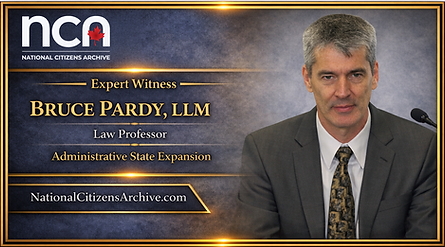
Mr. Bruce Pardy LLM
Law Professor
Expert
Witness ID:
NCI-W-041
Hearing
Toronto
Ontario
Date:
March 30, 2023
Report
Inquiry into the Appropriateness and Efficacy of the COVID-19 Response in Canada; November 2023
Main Topic
How delegation, judicial deference, and Charter interpretation enabled expansion of the administrative state during COVID-19.
One Line Summary
Law professor Bruce Pardy testified that COVID measures succeeded legally because courts deferred to an expanded administrative state and the Charter now facilitates rather than restrains that structure.
Synopsis
Dr. Bruce Pardy testified that the primary legal reason COVID measures survived court challenges was the long-standing expansion of the administrative state, characterized by legislative delegation of rulemaking authority to executive officials, judicial deference to administrative expertise, and broad discretion to define the public good. He argued that this structural evolution, rather than the specific merits of masking, lockdowns, or vaccines, explains why courts upheld most pandemic measures. In his view, once officials are accepted as having authority to determine the public good, judicial review largely affirms their decisions.
He further testified that the Canadian Charter of Rights and Freedoms did not meaningfully restrain this expansion. He explained that indirect coercive mechanisms—such as vaccine passports and employment consequences—avoided direct violations of Section 7 bodily autonomy protections. He highlighted the broad “reasonable limits” clause in Section 1, judicial deference to public health expertise, and instances where courts took judicial notice of vaccine safety and efficacy. He characterized the Charter as increasingly functioning as a legitimizing instrument for state intervention rather than a barrier against it.
Pardy proposed that meaningful reform would require reconsidering delegation standards through a non-delegation doctrine, restoring clearer separation of powers, and re-evaluating how courts apply deference and mootness. He argued that policy decisions of government are largely insulated from liability, creating a disconnect between authority and accountability. In his view, the pandemic revealed not merely flawed policies but a structural constitutional evolution that prioritizes managerial governance over individual autonomy.
🔎 How to Search the Transcript
Click the “Read Transcript” button to open the witness testimony in your browser.
Once the transcript PDF is open, you can search for any word or phrase within the document using your browser’s search feature:
-
Windows: Press Ctrl + F
-
Mac: Press Command (⌘) + F
A small search box will appear. Type the word or phrase you are looking for, and the browser will highlight every occurrence within the transcript.
This makes it easy to quickly locate specific topics, names, or statements within the testimony.